Of course, there are at least as many ways to catch a fish as skin a cat. For instance, Paul is an accomplished sport fisher and I think it's especially strange for him to see so many and such beautiful fish running straight into our hold each set. We and the rest of the fleet do catch quite a few; however, since the state took over the fishery from the Japanese, the Alaska salmon industry has become one of the most well-managed sustainable agro-industries on the planet.
The basic concept behind our work is fairly simple: lay out a net, tow on it so the fish bunch up, haul in the net and dump the fish in the boat. However, the actual practice of the craft--the knowing of where and when to fish, of the dozen or so sub-trades necessary to keep a vessel functional (net-sewing, engine repair, carpentry, welding...), that actual practice is as full of challenge, complexity, and risk as any.
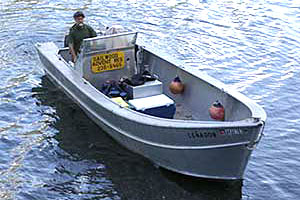
As I've mentioned, our boat is outfitted for a type of fishing called seining or purse-seining (as opposed to dragging, or gill netting with drift- or set-nets). The boat has a large stern deck that holds the net. One end of the net is connected to the boat; the other is connected to a smaller skiff. When we are ready to make a "set," our captain gives the word, we release the line tying the skiff to the stern, and our skiff driver pulls away in the opposite direction. The skiff functions as a sort of mobile anchor, executing smaller maneuvers, and maintaining the shape of the set.
The net is stacked so as to easily roll off the back deck; the skipper lays it out, trying to achieve a long arc (usually off a point or at the mouth of a bay). Our net is 250 fathoms long (a fathom is about 6 feet) and contains four main elements: a floating cork line, a weighted lead line, the purse line, and the webbing itself. Between the corks and the leads, there are up to 20 fathoms of webbin. The leads stretch the web down towards the bottom. Since the lead line is shorter than the cork line, the bottom of the net automatically puckers a little.
When we are towing the net, this creates a physical barrier and an area of higher pressure that work to push the fish back up toward the surface and the center of the set. Since we set against the direction the salmon are instinctively swimming, those that get spit back up in this manner generally turn to swim back into the net.
Once the net is laid out, we tow for 20-30 minutes. Eventually (as is actually happening now) the captain and the skiffman turn their vessels toward each other, turning the arc into a circle and closing the net. It's at this point that the purse line enters the process. The purse line actually runs through a series of steel rings that sit below the leads and are connected to them by shorter lines.
One end of the purse line is kept on deck from the beginning of the set; the other is spliced to the "king ring" at the opposite end of the net. Once we have hauled the king ring on deck, we begin tightening using a powerful deck winch (usually referred to by one of a variety of strictly non-PC terms, the tamest of which is "gypsy-head"). As we tighten the purse, the natural pucker in the bottom of the net is exaggerated to cinch the bottom of the net together. At this point we've got something that resembles an upside-down purse.
From here, John and I finish hauling in and stacking the net, the skipper makes some disparaging remarks about Paul*, and we hopefully dump a few thousand pounds of salmon into our fish hold.
Here's a fast-forward version of a set as seen from the deck. Though the boat in the video has a slightly different set up, they're using essentially the same method we do to Catch Salmon.
*In the skipper's (and Paul's) defense, I actually overheard the boss say that Paul has a pretty good touch with the skiff, which can be a difficult monster for a greenhorn to handle. In fact, despite all his barking, he is fond of saying that he has no complaints about any of us newbs or our work, other than the fact that we "can't keep his damn galley from looking like a ****in pigsty!"


2 comments:
Cool video! That is some serious length of netting! Great to have a visual of what you just described. I was amused at the audio at the end of the video of the salmom flipping and flopping on deck :)
When we get fish on our boat we have the added audio bonus of my fellow deckhand John shite-ing his pants, and the Skipper yelling at him to calm down.
Post a Comment